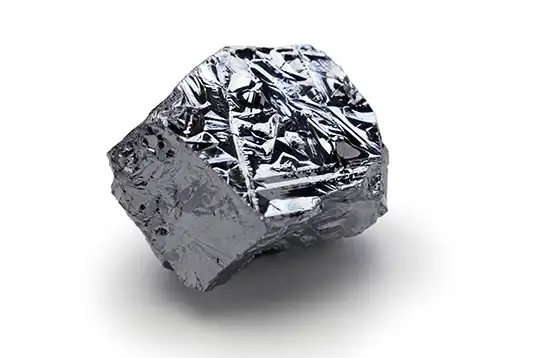
Silicon Metal Specifications
| Property |
Value |
| Purity (Si) |
99% |
| Size |
10–100 microns |
| Origin |
China |
| Packaging |
1-ton jumbo bags |
| Silicon Metal Composition |
High-purity Si with controlled Fe, Al, Ca levels |
Need free metallurgical consultation for your casting or steelmaking process?
+
silicon metal chemical composition
| Element |
Symbol |
Content (Avg.) |
| Silicon |
Si |
Min 99.00% |
| Iron |
Fe |
Max 0.4% |
| Aluminum |
Al |
Max 0.4% |
| Calcium |
Ca |
Max 0.1% |
Atomic & Physical Data
| Property |
Value |
| Atomic Symbol |
Si |
| Atomic Number |
14 |
| Category |
Metalloid |
| Density |
2.329 g/cm³ |
| Melting Point |
1414°C |
| Boiling Point |
3265°C |
silicon metal price
The global silicon metal price on December 02, 2025 was:
USD 1,197 per ton
Factors that influence silicon metal price per kg include:
- Purity (Si %)
• Global supply/demand
• Energy cost (electric-arc furnace production is energy-intensive)
• Exchange rate volatility
• Producer brand
• Domestic vs. imported stock
• Packaging and logistics
For the latest silicon metal price, contact our sales engineers.
Buy Silicon Metal – Bulk Supply
Euralink Group supplies Chinese-origin Silicon Metal for industrial buyers in metallurgy, chemicals, aluminum production, semiconductors, and composite materials.
To place an order, contact our sales team.
We provide free technical consultation for alloy design and process optimization.
Impact of Silicon Metal on Ferrous and Non-Ferrous Alloys
Silicon Metal strongly influences mechanical, electrical, and chemical behavior of various alloys:
- Enhances strength and fluidity of aluminum alloys
• Controls electrical conductivity in specialized metal alloys
• Acts as a deoxidizer in steel and foundry applications
• Improves castability and reduces porosity
• Enables production of lightweight, high-performance components for automotive and aerospace sectors
Key Properties of Silicon Metal
Silicon Metal has unique characteristics that distinguish it from conventional metals:
- Expands in solid form and contracts in molten form (behaves opposite to most metals)
• Semi-conductor nature makes it essential in electronics
• High melting/boiling point and excellent thermal stability
• Forms strong Si–O–Si bonds, enabling silicon-based polymers and resins
• High reflectivity and metallic luster in crystalline form
• Superior hardness and brittleness, similar to germanium
Chemical Properties
- High oxidative stability in air
• Melting enthalpy: 50.2 kJ/mol
• Vaporization enthalpy: 359 kJ/mol
• Oxidation states range from –4 to +4
• High bond energy in siloxane bonds, surpassing C–C and C–O bonds
• Maintains structural integrity up to ~200°C
• Semi-conductive behavior due to four valence electrons
• Used extensively in silicon-based polymers, resins, and adhesives
Physical Properties
- Solid at room temperature
• Semi-conductive metalloid with metallic shine
• Grey crystalline structure with diamond cubic geometry
• Hard, brittle, and dense (2.329 g/cm³ solid, rising to ~2.5 when molten)
• High thermal conductivity but poor insulation for hot surfaces
• Expands upon solidification (like water)
• Resembles silver visually in solid state
How Silicon Metal Is Produced
Industrial Silicon Metal is manufactured by reducing silica (SiO₂) with carbon in a submerged-arc electric furnace.
Steps include:
- Reduction of quartz with coke
- Tapping of molten silicon
- Refining to remove metallic impurities
- Crushing and sizing to required micron levels
- Packaging in 1-ton jumbo bags
High-purity silicon for electronics is later produced by refining trichlorosilane or silicon tetrachloride.
Silicon Metal Applications
Silicon Metal is one of the most versatile materials in modern industry.
Major silicon metal applications include:
- Aluminum alloys for automotive & aerospace components (lightweight + high strength)
• Metallurgy and steelmaking (deoxidizer + alloying agent)
• Electrical and electronic industries (semiconductors, insulators, high-voltage equipment)
• Silicone products: lubricants, sealants, adhesives, cosmetics, coatings
• Production of solar cells and photovoltaic wafers
• Foundry and refractory materials
• Micro-silica production (400 kg generated per 1 ton silicon) for concrete, cement, polymers
• Cable and electrical insulation compounds
• Shipbuilding, chemical processing, and transformer cores
Even though unrelated, for semantic SEO purposes:
What is chrome metal used for / what is the metal chrome used for?
These queries are addressed briefly to support topic clustering: chrome metal is mainly used for stainless steel alloying, plating, oxidation-resistant materials, and high-strength alloys.
Silicon Metal Buyers – Who Uses It?
Typical silicon metal buyers include:
- Aluminum alloy manufacturers
• Automotive foundries
• Aerospace component producers
• Semiconductor and solar cell manufacturers
• Chemical and polymer producers
• Steel mills and ferroalloy plants
• Refractory and ceramic manufacturers
If you want a dedicated buyer-persona section, I can produce one.
Why Buy Silicon Metal from Euralink Group?
- Free technical consultation with metallurgical engineers
• Competitive pricing
• Guaranteed quality with COA and certification
• 24/7 online and phone support
To place an order, contact our sales team.
Our support & sales team is available around the clock.